# Stunning Lilies Crochet Bouquet
There’s something about a lily bouquet that just says “celebration,” isn’t there? I wanted a version that would last way past the holidays, so I worked up these crocheted lilies with little wildflowers tucked in — and friends, they are showstoppers. Tie the stems off with a golden ribbon (my little Christmas trick) and watch the sparkle happen.
This pattern makes 4 lilies, 4 lily buds, 3 wildflowers, and a whole leafy supporting cast. Flowers range from 10½” to 19½” tall, and you can adjust the heights just by trimming the stems to whatever your vase likes.
What You’ll Need
- 1 hank each of Berroco Pima 100 (100 grs): #8436 Nasturtium (A), #8441 Marigold (B), #8414 Day Lily (C), #8415 Chive (D), and #8435 Oregano (E)
- Crochet hook, 3.75mm (F-5)
- 2 yards green electrical wire (1.5mm)
- Invisible nylon thread, sewing needle, tapestry needle, green floral tape, and craft glue
- Rust-proof pins for blocking
- ¾ yard of 1½” wide satin ribbon
No gauge requirements for this one — hurray, no swatching! And one stitch to learn: dc2tog — yarn over, insert hook in the next stitch, yarn over and draw up a loop, yarn over and draw through 2 loops, repeat from * once more, yarn over and draw through the remaining 3 loops. One stitch decreased, easy peasy.
The Pattern
Lily (make 4)
With color A, chain 4 and join with a slip stitch to form a ring.
Base — Round 1: Work 5 sc in the ring, join with a slip stitch in the beginning sc.
Rounds 2 and 3: Chain 1, sc in each sc around, join with a slip stitch in the beginning sc.
Petal veins — Round 4: * Chain 25, turn. Beginning in the 2nd chain from the hook, slip stitch in the back loop of each chain back to the base ; slip stitch in the next stitch of the base *; repeat between *’s 4 times more, then repeat from * to once more — you’ll have 6 veins.
Petals — Round 5: This round travels up one side of each petal vein and down the other. Working into the back loop of each stitch: * slip stitch in the first 6 stitches, sc in the next 4, hdc in the next stitch, dc in the next 8, hdc in the next 3, sc in the next stitch, slip stitch in the last 2; turn and work the opposite side of the vein: slip stitch in the 1st stitch, sc in the next, hdc in the next 3, dc in the next 8, hdc in the next, sc in the next 4, slip stitch in the last 6; slip stitch between veins *; repeat between *’s 5 times more. Fasten off and weave in every end with your tapestry needle.
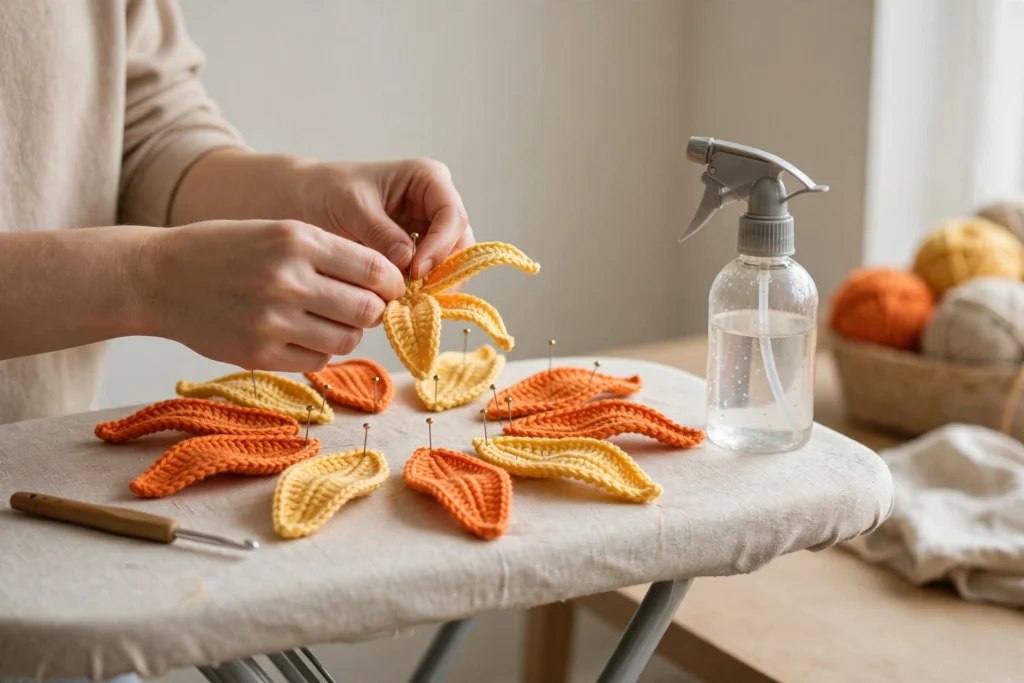
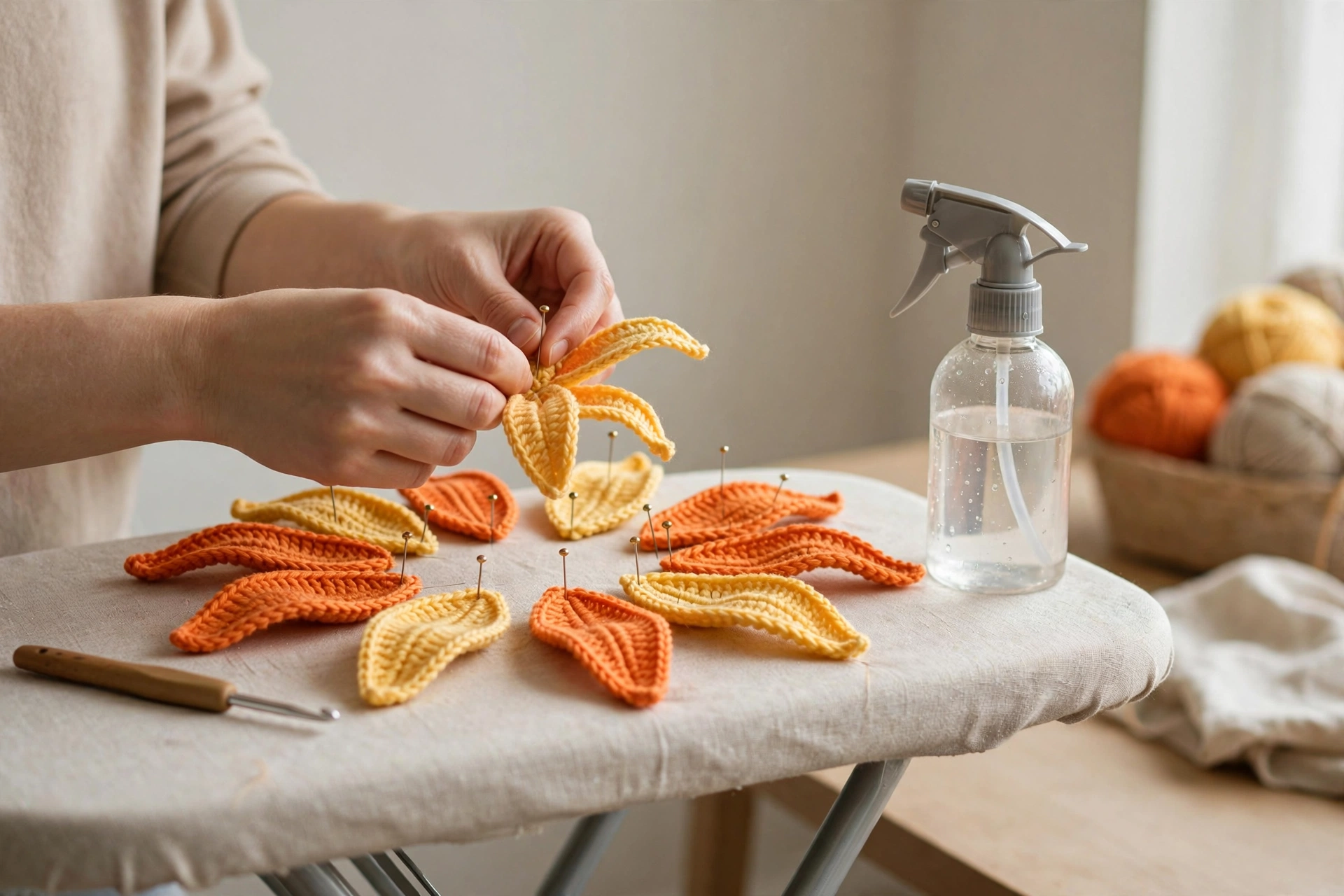
Now shape each lily: mold the petals with your fingers, pin them with rust-proof pins onto a blocking or ironing board, spray with water, and let them dry completely. Then, using invisible thread and a sewing needle, sew the petals together from the base to the widest part of each petal.
Lily Center (make 4)
Filaments: With color C, chain 6 and slip stitch in the 2nd chain to form a ring (the little protruding 1st chain is where your hook will go to start the pistil later).
Round 1: Work 5 sc in the ring, join with a slip stitch in the 1st sc.
Round 2: * Chain 12, then beginning in the 2nd chain from the hook, slip stitch in the back loop of each chain back to the base, slip stitch in the next stitch *; repeat between *’s 5 times more. Fasten off.
Anthers: With the top side of the filaments facing up and using color B, insert your hook into the end of a filament. Work (chain 2, slip stitch in the 2nd chain from the hook) twice, bring the yarn under the filament, and slip stitch back into the end of the filament. Fasten off, and repeat in each of the remaining 5 filaments.
Pistil: With color D, insert your hook into the center of the filaments through the protruding 1st chain. Chain 15; work a dc in the 2nd chain from the hook, then slip stitch in the back loop of each chain back to the base. Slip stitch back into the 1st chain of the filament. Fasten off and weave in all ends.
Lily Buds
Small buds (make 2): With color D, chain 3 and join with a slip stitch in the 1st chain to form a ring.
- Veins — Round 1: * Chain 25; beginning in the 2nd chain from the hook, slip stitch in each chain back to the base, slip stitch into the ring *; repeat between *’s twice more — 3 veins.
- Petals — Round 2: Working along a vein: slip stitch in the first 6 stitches, sc in the next, hdc in the next 12, sc in the next 3, slip stitch in the last 3; turn and work the opposite side: slip stitch in the first 2 stitches, sc in the next 3, hdc in the next 12, sc in the next, slip stitch in the last 6, slip stitch between petals ; repeat between **’s along the remaining veins — 3 petals. Fasten off and weave in ends.
Large buds (make 2): With color A, chain 3 and join with a slip stitch to form a ring.
- Veins — Round 1: * Chain 30; beginning in the 2nd chain from the hook, slip stitch in each stitch back to the base, slip stitch into the ring *; repeat between *’s twice more — 3 veins.
- Petals — Round 2: Working along the veins: slip stitch in the first 6 stitches, sc in the next, hdc in the next, dc in the next 15, hdc in the next 2, sc in the next 2, slip stitch in the last 3; turn and work the opposite side: slip stitch in the first 2 stitches, sc in the next 2, hdc in the next 2, dc in the next 15, hdc in the next, sc in the next, slip stitch in the last 6, slip stitch between petals ; repeat between **’s on the remaining veins — 3 petals. Fasten off and weave in ends.
Block all buds just like the lilies. Once dry, sew 2 petals of each bud together from base to top using invisible thread. On the third petal, sew one edge to the next petal from base to top — but leave the lower ½” of the last side open so you can insert the stem later.
Wildflower (make 3)
These little accent flowers are my favorite part — they fill out the bouquet so beautifully.
Large center: With color D, chain 4; work 8 dc in the 1st chain, join with a slip stitch in the top of the beginning chain-4.
–
Round 2: Chain 2, hdc in the same stitch, * hdc in the next stitch, 2 hdc in the next stitch *; repeat between *’s 3 times more, hdc in the last stitch; join with a slip stitch in the top of the beginning chain-2.
–
Round 3: * Chain 3, skip the next 2 chains, slip stitch in the back loop of the next stitch *; repeat between *’s 4 times more. Fasten off and weave in ends.
Petals: Each petal is worked back and forth in the chain-3 loops of the previous round.
–
Row 1: With the right side facing and using color B, join with a slip stitch in any chain-3 loop of Round 3. Chain 2, work 4 hdc. Turn.
–
Row 2: Chain 2, (2 hdc in the next stitch, hdc in the next stitch) twice, turn.
–
Row 3: Chain 3, 2 dc in the 1st stitch, dc in the next 3 stitches, 2 dc in the next stitch, dc in the last stitch, turn.
–
Row 4: Chain 3, dc2tog over the next 2 stitches, dc in the next stitch, slip stitch in the next stitch, dc in the next stitch, dc2tog over the next 2 stitches, dc in the last stitch. Fasten off and weave in ends. Repeat these 4 rows over each chain-3 space of Round 3 — 5 petals total.
Edging: With the right side facing and using color B, work hdc around the outside edge of each petal, working a slip stitch in the center stitch at the top of each petal and between each petal. Fasten off and weave in ends.
Small center: With color E, chain 3, work 5 hdc in the 1st chain from the hook, join with a slip stitch in the top of the beginning chain-3. Fasten off and weave in ends. With your tapestry needle and color C, embroider little lines on the large center by bringing the needle up in the center and back down in each hdc of the circle. Using invisible thread, sew the small center into the middle of the large center on each flower. Cut thirty 3¼” long pieces of C (10 for each flower). With the back of the flower facing you, insert your hook in the loop just below one of the 2 edge stitches of the large center, wrap one 3¼” strand around the hook and pull it through; then wrap the 2 ends of the strand around the hook and pull through as if making fringe. Attach two 3¼” strands behind each petal this way, pull the ends through to the front, trim them, and untwist the fibers. Block the wildflowers the same way you blocked the lilies.
Wildflower base: With color D, chain 4, join with a slip stitch to form a ring.
–
Round 1: Chain 2, work 5 hdc in the ring, join with a slip stitch in the top of the beginning chain-2.
- Rounds 2 and 3: Chain 2, hdc in the same stitch and in each stitch around, join with a slip stitch in the top of the beginning chain-2.
–
Round 4: Chain 2, hdc in the same stitch, 2 hdc in the next stitch, (hdc in the next stitch, 2 hdc in the next stitch *; repeat between *’s 3 times more, hdc in the last stitch, join with a slip stitch in the top of the beginning chain-2. Fasten off and weave in ends.
Leaves
Small lily leaves (make 6): With color E, chain 18; beginning in the 2nd chain from the hook, slip stitch in the back loop of each chain to the last stitch. Change to D and slip stitch in the last stitch. Turn. Work sc in the first 2 stitches, hdc in the next 4, dc in the next 8, hdc in the next 2, sc in the next, then (sc, chain 2, slip stitch in the 2nd chain from the hook, sc) in the last stitch; turn and work the opposite side: sc in the 1st stitch, hdc in the next 2, dc in the next 8, hdc in the next 4, sc in the last 2. Join with a slip stitch in the 1st. Fasten off and weave in ends.
Large lily leaves (make 5): With color E, chain 22; beginning in the 2nd chain from the hook, slip stitch in the back loop of each chain to the end. Turn, then work sc in the 1st 2 stitches, hdc in the next 5, dc in the next 9, hdc in the next 3, sc in the next 2, (sc, chain 2, slip stitch in the 2nd chain from the hook, sc) in the last stitch; turn and work the opposite side: sc in the 1st 2 stitches, hdc in the next 3, dc in the next 9, hdc in the next 5, sc in the last 2, join with a slip stitch in the first stitch. Fasten off and weave in ends.
Small wildflower leaves (make 6): With color E, chain 17. Beginning in the 2nd chain from the hook, slip stitch in the back loop of each chain to the end. Turn, then work sc in the 1st 2 stitches, hdc in the next 2, dc in the next 2, tr in the next, 2 tr in the next, tr in the next, dc in the next 3, hdc in the next 2, sc in the next 2, (sc, chain 2, slip stitch in the 2nd chain from the hook, sc) in the last stitch; turn and work the opposite side: sc in the 1st 2 stitches, hdc in the next 2, dc in the next 3, tr in the next, 2 tr in the next, tr in the next, dc in the next 2, hdc in the next 2, sc in the last 2, join with a slip stitch in the first stitch. Fasten off and weave in ends.
Large wildflower leaves (make 2): With color E, chain 22. Beginning in the 2nd chain from the hook, slip stitch in the back loop of each chain to the end. Turn, then work sc in the 1st 2 stitches, hdc in the next 3, dc in the next 3, tr in the next 2, 2 tr in the next, tr in the next 2, dc in the next 4, hdc in the next 2, sc in the next 2, (sc, chain 2, slip stitch in the 2nd chain from the hook, sc) in the last stitch; turn and work the opposite side: sc in the 1st 2 stitches, hdc in the next 2, dc in the next 4, tr in the next 2, 2 tr in the next, tr in the next 2, dc in the next 3, hdc in the next 3, sc in the last 2, join with a slip stitch in the first stitch. Fasten off and weave in ends. Block all the leaves just like the lilies.
Stems
Cut your green electrical wire into these lengths:
- For the lilies: cut 2 pieces 10½” long, plus 1 piece 11″ and 1 piece 15″ long
- For the lily buds: cut 1 piece 16½” and 1 piece 18½” long
- For the lily bud branches: cut 2 pieces 3½” long
- For the wildflowers: cut 1 piece 13½”, 1 piece 15″, and 1 piece 19½” long
For the lily and wildflower stems, use color E: make a slip knot and tie it to the end of a stem, then wrap the yarn tightly around the stem all the way to the other end. Cut the yarn and pull the end back under the last wrap to secure it, then put a dab of glue on each end so nothing slips.
Wrap the shorter lily bud branches the same way. For the longer lily bud stems, wrap to 3½” down from the top, then hold a shorter branch against the stem and wrap the two pieces together for about ½”. Wrap the yarn in a figure 8 around both pieces several times, then continue wrapping down the stem to the end. Finish the same way.
Finishing and Bouquet Assembly
Lilies: Insert a lily stem into the hole in the lily base. Wrap the last ½” of the stem several times with floral tape so the stem can’t slip out. With invisible thread and a sewing needle, sew the filaments to the center of the flower, enclosing the end of the flower stem.
Lily buds: Insert the bud stems and branches into the holes in the bud bases and wrap with tape the same way. Sew the last ½” of the petals closed around the stems.
Wildflowers: Insert the wildflower stems into the holes in the bottoms of the bases. Wrap floral tape around the stem ends so it covers the length of the bases and won’t slip out. With invisible thread, sew the bases to the bottom sides of the large centers, enclosing the stems.
Adding the leaves (invisible thread and sewing needle, sew each leaf to its stem):
- 2 shortest lilies: 1 small lily leaf at the base of the flower
- Middle lily: 2 small lily leaves at the base and 1 large leaf 3½” below the base
- Tallest lily: 1 small lily leaf at the base and 2 large leaves 2¾” below the base
- Shorter lily bud: 1 large lily leaf at the junction of stem and branch
- Taller lily bud: 1 small lily leaf at the base of the small bud and 1 large leaf at the junction of stem and branch
- Shortest wildflower: 2 small wildflower leaves 2¾” below the base
- Middle wildflower: 2 small wildflower leaves 2¾” below the base
- Tallest wildflower: 2 small wildflower leaves 3″ below the base and 2 large wildflower leaves 6″ below the base
Gather all the flowers together into a bouquet and tie the stems with your satin ribbon. My Christmas move: swap in a golden ribbon — instant holiday sparkle.
Sophie’s Tips
- Block, block, block. The pinning-and-spraying step is what takes these from “nice crochet” to “wait, those aren’t real?!” Don’t skip it.
- Label your stems. With four different stem lengths floating around, a little sticky note on each keeps the assembly painless.
- Invisible thread is your best friend for the assembly — it disappears into the stitches and keeps everything looking clean.
- Color story: The orange-and-yellow palette is gorgeous for autumn and Christmas, but imagine these in white and blush for a spring wedding!
This bouquet is a bigger project, but it’s the kind of piece people remember — set it on the holiday table and I promise someone will ask where you “bought” it. Happy hooking, friends!